
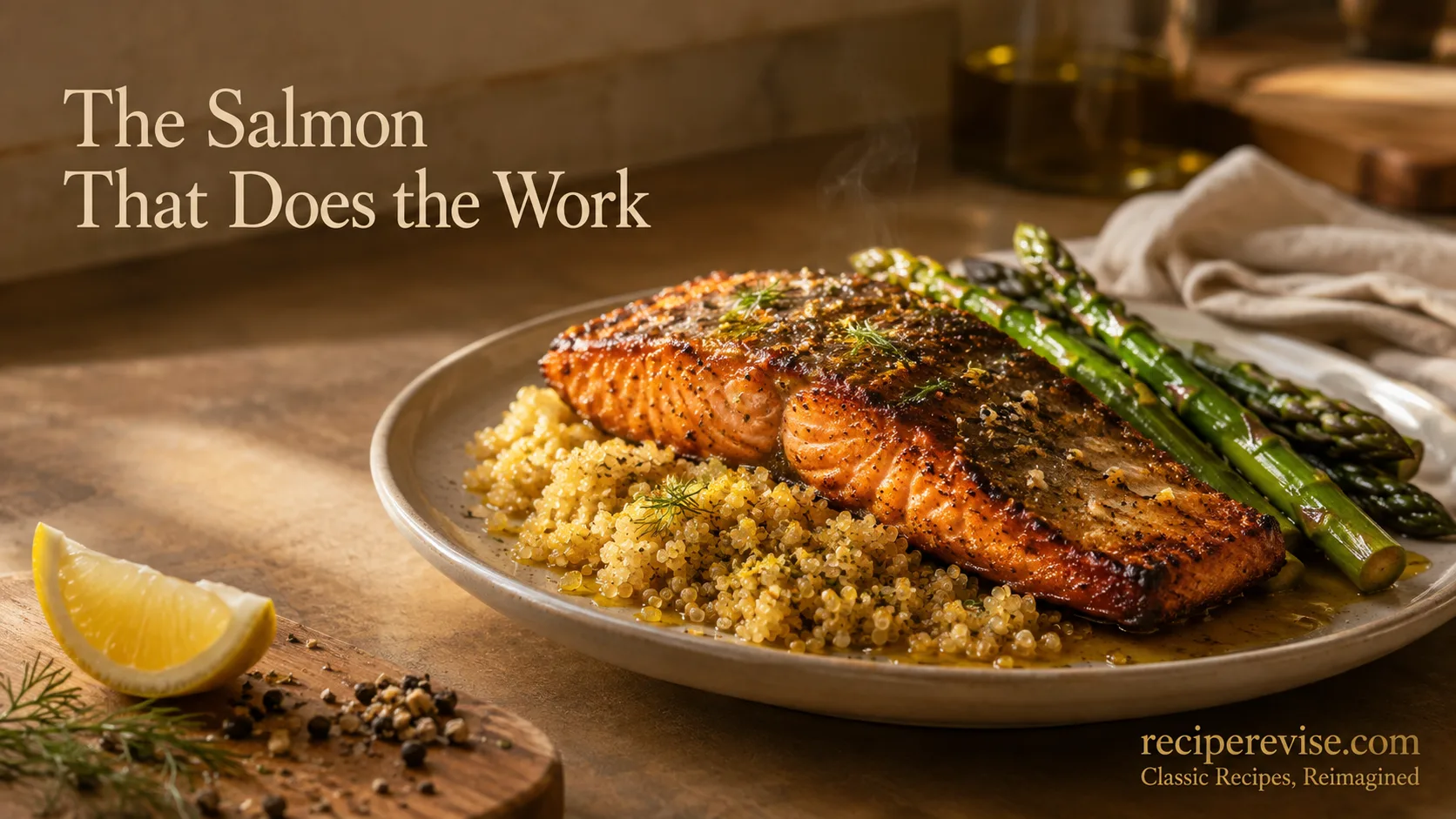
Lemon-garlic baked salmon with quinoa & asparagus: a low-sodium, heart-healthy dinner backed by real research. Save it for the weeknight that needs it most.
By Pepper Sage
Medical Disclaimer: Nothing here replaces a personalized plan from your Registered Dietitian, endocrinologist, or cardiologist. Bring this article to your next appointment — don’t use it instead of one. If you take blood pressure medication, blood thinners, or have Stage 3+ CKD, the potassium and vitamin K notes below matter. Read them before you cook.
The 40-second answer
If you’re living with hypertension, high LDL, and Type 2 diabetes at once, you don’t need three diets fighting each other. One anti-inflammatory pattern — modified Mediterranean-DASH-MIND — targets all three at their shared root: vascular inflammation. Keep sodium under 1,500 mg, potassium above 3,500 mg, saturated fat under 6% of calories, and add ~30 g of viscous fiber daily. That’s the whole game.
Why doctors call this the “big three” — and why they behave like one disease
Here’s the frustrating part nobody explains at the pharmacy counter: high blood pressure, high cholesterol, and Type 2 diabetes aren’t three separate problems sharing a body. They’re three symptoms of one underlying process — endothelial dysfunction and chronic low-grade inflammation of the blood vessel lining. Your arteries stiffen, your pancreas overworks, your liver spits out excess LDL, and it all feeds itself.
The numbers are sobering. The prevalence of concurrent diabetes and hyperlipidemia among U.S. adults with hypertension nearly doubled from 12.5% to about 22% between 1999 and 2020, and coexisting hypertension plus T2D alone climbed from 6% to 12% of American adults in that same window. If you feel like this cluster is everywhere now — it is.
The good news, and this is the part I want you to actually hear: the same food fixes all three. Not metaphorically. Biochemically. That’s the whole premise of what follows.
What actually goes wrong at the plate level
The conflict you’ve been told about is largely fake. For decades, patients have been handed contradictory instructions — cut carbs for blood sugar, cut fat for cholesterol, cut salt for blood pressure — as if each condition demanded its own kitchen. It doesn’t. A modified Mediterranean-DASH-MIND pattern hits all three targets with the same grocery list. In a 2025 RCT, three months on the MIND framework produced meaningful reductions in fasting blood sugar, LDL cholesterol, and blood pressure simultaneously versus a standard calorie-restricted diet.
Here’s the mechanism, stripped of jargon: chronic inflammation damages the delicate inner lining of your blood vessels (the endothelium). That damage makes vessels stiffer (→ higher BP), traps LDL particles in artery walls (→ plaque), and makes muscle and liver cells stop listening to insulin (→ higher glucose). Anti-inflammatory foods reverse the signal on all three fronts at once.
Think of your bloodstream as a river. Sodium overload is silt building up on the banks. Saturated fat is grease slicking the surface. Excess glucose is sugar dumped in that feeds algae blooms. You don’t clean a river by attacking one pollutant — you shift the whole current.
The Dietary Solution Matrix: one ingredient, multiple wins
This chart is the shortcut I wish every newly-diagnosed patient got handed. It’s the reason your grocery cart is about to get simpler, not more complicated.
| Ingredient | Blood Pressure | Cholesterol | Blood Sugar | The Why |
|---|---|---|---|---|
| Fatty fish (salmon, sardines) | ✅ ✅ | ✅ | ✅ | ~2–3 g/day EPA+DHA lowers BP and triglycerides (AHA, 2022) |
| Extra virgin olive oil (high-polyphenol) | ✅ | ✅ ✅ | ✅ | Restores endothelial function; replaces saturated fat 1:1 (Kourek, 2025) |
| Lentils & pulses | ✅ | ✅ ✅ | ✅ ✅ | Daily lentils lowered LDL, total cholesterol, and postprandial glucose in a 12-week RCT (Chamberlin, 2024) |
| Oats & barley (β-glucan) | ✅ | ✅ ✅ | ✅ ✅ | Viscous fiber slows gastric emptying and traps bile acids (Bozbulut, 2019) |
| Leafy greens (spinach, arugula, kale) | ✅ ✅ | ✅ | ✅ | Dietary nitrates + potassium; low glycemic load |
| Berries (blueberries, strawberries) | ✅ | ✅ | ✅ | Anthocyanins improve insulin sensitivity (Solverson, 2019) |
| Almonds/walnuts (¼ cup) | ✅ | ✅ ✅ | ✅ | Almonds meta-analysis: LDL down ~0.13 mmol/L across 36 RCTs (Musa-Veloso, 2025) |
| Quinoa | ✅ | ✅ | ✅ ✅ | GI ~53, magnesium-dense; smaller postprandial spike than rice (Zhang, 2024) |
Notice something? There’s no “diabetes column” and “cholesterol column” fighting each other. It’s the same list.
The sodium-potassium truth nobody quite says out loud
You’ve been told to “cut salt.” That’s half the sentence. The AHA now recommends less than 2,300 mg sodium daily, with an optimal target of 1,500 mg for anyone with hypertension (AHA). But the newer science — and this is what changed my kitchen — is that the sodium-to-potassium ratio matters at least as much as sodium alone. In the massive SSaSS trial (~20,000 participants), swapping regular salt for a 75% sodium chloride / 25% potassium chloride blend cut stroke risk 14% and cardiovascular events 13%.
Here’s the catch — and it’s a big one. Potassium-based salt substitutes are dangerous for anyone with moderate-to-advanced CKD, on ACE inhibitors, ARBs, or potassium-sparing diuretics like spironolactone. The National Kidney Foundation explicitly warns against them for CKD patients. Talk to your doctor before you buy a jar. If you’re cleared, the SSaSS-style substitute is one of the most cost-effective interventions in cardiology. If you’re not, the swaps below still work beautifully.
The flavor-first swap list (all CKD-safe)
- Instead of table salt on chicken: lemon zest + smoked paprika + granulated garlic
- Instead of soy sauce: aged balsamic + a pinch of miso (yes, miso — a teaspoon of white miso has less sodium than one tablespoon of soy sauce and adds glutamates that trick your tongue into perceiving “salty”)
- Instead of bouillon cubes: homemade mushroom-and-kombu broth, or Better Than Bouillon’s no-salt-added base
- Instead of taco seasoning packets: cumin + coriander + oregano + chipotle powder + lime
- Instead of Italian dressing: EVOO + red wine vinegar + Dijon + fresh basil
I keep a small ramekin of lemon zest and one of toasted sesame seeds by my stove. That combination alone has replaced probably 400 mg of daily sodium in my own cooking.
The 7-Day Meal Plan: built for the tired weeknight, not the food photographer
A plan you can’t cook when you’re exhausted is just a beautifully-plated failure. Everything below assumes one 45-minute Sunday prep window and short weeknight assembly. Sodium sits under ~1,500 mg daily; each day delivers roughly 3,500–4,200 mg potassium (from food — no salt substitute needed).
Sunday prep (do these five things, everything else falls together)
- Cook 3 cups of quinoa. Cool, refrigerate.
- Cook 2 cups of dry green lentils. Cool, refrigerate.
- Hard-boil 6 eggs.
- Roast one large tray: broccoli, red bell pepper, red onion, zucchini in EVOO + garlic powder + black pepper.
- Whisk one jar of dressing: ¼ cup EVOO, 2 tbsp lemon juice, 1 tsp Dijon, 1 tsp dried oregano, black pepper. No salt.
The Weekly Matrix
| Day | Breakfast | Lunch | Dinner | Snack |
|---|---|---|---|---|
| Mon | Steel-cut oats + blueberries + walnuts + cinnamon | Lentil-quinoa bowl with roasted veg + lemon dressing | Lemon-Garlic Baked Salmon with quinoa & asparagus | Plain Greek yogurt + strawberries |
| Tue | Greek yogurt parfait: yogurt, chia, raspberries, almond slivers | Leftover salmon flaked over arugula + white beans + EVOO | Turkey-lentil chili (no-salt tomatoes, cumin, chipotle) | Apple + 12 almonds |
| Wed | Veggie scramble (2 eggs + spinach + tomato) + ½ avocado on rye | Chili leftovers over quinoa | Sheet-pan Mediterranean chicken thighs, roasted peppers, farro | Hummus + cucumber |
| Thu | Overnight oats + peanut butter + banana + flaxseed | Big salad: greens, chickpeas, roasted veg, hard-boiled egg, dressing | Miso-glazed cod, brown rice, bok choy | Handful of walnuts + orange |
| Fri | Cottage cheese (low-sodium) + blueberries + pumpkin seeds | Whole-wheat wrap: hummus, roasted veg, spinach, feta (light) | Shrimp & white bean stew with kale & tomatoes | Pear + 1 oz dark chocolate (85%) |
| Sat | Two-egg omelet + mushrooms + herbs + whole-grain toast | Sardine-avocado toast on rye + tomato slices | Grilled chicken souvlaki, tzatziki, tabbouleh | Greek yogurt + honey (½ tsp) + walnuts |
| Sun | Buckwheat pancakes + berry compote (no sugar) + Greek yogurt | Roasted veggie & lentil soup + side salad | Herb-crusted pork tenderloin, cauliflower mash, sautéed spinach | Air-popped popcorn + nutritional yeast |
Fluid rule I live by: water first, unsweetened green tea second, coffee capped at two cups before noon, and one glass of red wine with dinner only if your doctor has cleared alcohol given your medications.
Featured Recipe: Lemon-Garlic Baked Salmon with Quinoa and Steamed Asparagus
This is the workhorse dish. If you cook nothing else from this article, cook this on repeat. Four ingredients do most of the medical work: salmon (EPA/DHA), EVOO (polyphenols), garlic (allicin, mild BP support), and lemon (acidity so bright you forget the salt shaker exists).
Why it works
The 2–3 g of EPA + DHA in a 6 oz salmon fillet sits at the sweet spot the AHA identified for meaningful blood pressure and triglyceride reduction. The high-polyphenol EVOO doesn’t just carry flavor — its oleocanthal and hydroxytyrosol restore nitric oxide signaling in the endothelium, which is the same pathway your BP medication targets. Quinoa’s GI of ~53 combined with its magnesium content means a slower glucose curve than white rice. Asparagus contributes potassium and folate. Everything on the plate is pulling in the same direction.
Ingredients (Serves 4)
- 4 × 6 oz wild salmon fillets, skin on
- 3 tbsp high-polyphenol extra virgin olive oil (look for a harvest date under 18 months old — that’s where the polyphenols live)
- 4 garlic cloves, minced
- Zest of 2 lemons + juice of 1
- 1 tbsp fresh dill, chopped (or 1 tsp dried)
- ½ tsp black pepper, freshly cracked
- ¼ tsp smoked paprika
- No added salt (the lemon and garlic do the flavor work)
- 1 cup dry quinoa, rinsed
- 2 cups low-sodium vegetable broth or water
- 1 lb asparagus, tough ends snapped off
Instructions
- Heat oven to 400°F (200°C). Line a sheet pan with parchment.
- Bring quinoa and broth to a boil, cover, reduce to lowest heat, cook 15 minutes. Let sit 5 minutes off the heat. Fluff.
- Whisk EVOO, garlic, lemon zest, lemon juice, dill, pepper, and paprika. Set aside 2 tbsp for finishing.
- Place salmon skin-down on the parchment. Spoon the remaining marinade over the fillets. Let sit 10 minutes at room temp.
- Bake 12–14 minutes for medium (internal temp 125°F for buttery texture, 145°F if you prefer well-done).
- Steam asparagus 4 minutes — bright green, still with a snap.
- Plate quinoa, top with salmon, arrange asparagus, and finish with the reserved 2 tbsp of the citrus-EVOO mixture.
Nutrition per serving (approximate)
Calories 520 · Protein 42 g · Carbs 38 g · Fiber 6 g · Fat 22 g (Sat 3 g) · Sodium 95 mg · Potassium 1,180 mg · Magnesium 165 mg
Clinical customization tips
- Severe Stage 3+ CKD: swap asparagus for green beans (lower potassium, ~180 mg per cup vs. asparagus at ~270 mg) and reduce quinoa to ½ cup cooked per serving.
- On warfarin: dill is fine, but keep leafy green intake week-to-week consistent so your INR stays predictable — don’t suddenly triple your spinach.
- Insulin-dependent T2D: the quinoa portion here is intentional. Weigh your cooked quinoa at 150 g per serving for a precise ~30 g carbohydrate count.
- Trying to lose weight: halve the quinoa, double the asparagus. Same medicine, fewer calories.
Featured Recipe #2: Herb-Crusted Pork Tenderloin with Cauliflower Mash
Because Sunday deserves something that looks like an occasion. Pork tenderloin is one of the leanest cuts in the meat case — comparable to skinless chicken breast for saturated fat, at about a third of the price per pound where I shop.
Why it works
Replacing beef or high-fat pork cuts with tenderloin is one of the saturated-fat swaps the AHA specifically endorses — because substituting saturated fat with unsaturated fat lowers LDL as effectively as some statin regimens. Cauliflower mash replaces the potato mash’s higher glycemic hit with a fiber-rich, potassium-still-decent alternative. The mustard-herb crust delivers savoriness without a grain of salt.
Ingredients (Serves 4)
- 1 pork tenderloin (~1.25 lb), silver skin trimmed
- 2 tbsp Dijon mustard (choose a brand under 120 mg sodium per tsp)
- 2 tbsp EVOO
- 3 garlic cloves, minced
- 2 tbsp fresh rosemary, chopped
- 2 tbsp fresh thyme leaves
- 1 tsp black pepper
- 1 large head cauliflower, cut into florets
- 2 tbsp EVOO (for mash)
- 1 tbsp fresh chives, snipped
- Zest of 1 lemon (for mash finish)
Instructions
- Heat oven to 425°F (220°C).
- Whisk Dijon, EVOO, garlic, herbs, and pepper. Coat the tenderloin fully. Rest 15 minutes.
- Sear the tenderloin in an oven-safe skillet over medium-high heat, 2 minutes per side, until the crust bronzes.
- Transfer skillet to oven. Roast 15–18 minutes until internal temp hits 145°F. Rest 10 minutes — non-negotiable — before slicing.
- Meanwhile, steam cauliflower 12 minutes until fork-tender. Drain thoroughly.
- Mash with EVOO, chives, and lemon zest. Pepper to taste.
Clinical customization tip
If you’re insulin-sensitive and want more carbs at dinner, add a small roasted sweet potato per plate — its slow-digesting starch pairs beautifully with the lean protein and won’t spike a stable T2D as much as white potato.
Reader FAQ
Can I really eat the same foods for high blood pressure, high cholesterol, and diabetes?
Yes, and the science is unusually clean on this. The Mediterranean-DASH-MIND pattern lowers blood pressure, LDL cholesterol, and fasting glucose simultaneously because all three conditions share endothelial inflammation as their common root. In a 2025 randomized trial, MIND-diet followers saw significant reductions in FBS, LDL, and BP together over 12 weeks — no separate diets required.
How much sodium is actually safe if I have all three?
The AHA recommends under 2,300 mg daily for the general population and an optimal target of 1,500 mg for anyone with hypertension, per current AHA guidance. The catch is that ~70% of Americans’ sodium comes from packaged and restaurant foods, not the salt shaker. Cooking from a plan like the one above naturally lands you around 1,200–1,500 mg without ever measuring.
Are salt substitutes with potassium chloride safe for me?
Only if your kidneys are healthy and you’re not on potassium-sparing drugs. The SSaSS trial showed a 75/25 sodium-potassium blend reduced stroke risk 14% in general users, but the National Kidney Foundation explicitly warns CKD patients away from potassium-based substitutes. Ask your doctor before switching, and if you’re cleared, the culinary swaps I listed above still work as well.
What if I hate fish?
Sardines on toast twice a week hits your omega-3 target with the smallest fish-cooking effort I know. If truly nothing scaly works for you, walnuts (1 oz daily) provide ALA — a less efficient omega-3 precursor, but real. An algae-based EPA/DHA supplement, dosed by your dietitian, is the fallback most cardiologists will support.
How fast will I see numbers change?
Blood pressure often drops within 2–3 weeks of consistent sodium reduction. LDL usually shifts meaningfully at 6–8 weeks (that’s how long it takes bile-acid turnover to reset). HbA1c reflects three months of blood sugar, so give it a full quarter before judging.
I live alone — how do I not waste food?
Halve the recipes, or cook full-size and freeze single portions of the chili, lentil soup, and pork. Salmon doesn’t freeze well after cooking — buy individually-wrapped fillets from the freezer aisle and thaw one at a time.
What about eggs — aren’t they bad for cholesterol?
For most people with T2D, up to one whole egg per day fits inside current ADA nutrition guidance, especially when it’s replacing refined carbs at breakfast. If your familial hypercholesterolemia has been flagged by your cardiologist, cap yolks at 3–4 per week and lean on whites.
One last thing
Cook the salmon this week. Just that. Skip the rest of the plan if you must — but the salmon-quinoa-asparagus trio is the closest thing I’ve found to a single-plate proof-of-concept that this whole “one diet, three conditions” idea actually works. Report back to your endocrinologist in twelve weeks. Bring your lab printout. Bring a fork.
— Pepper Sage