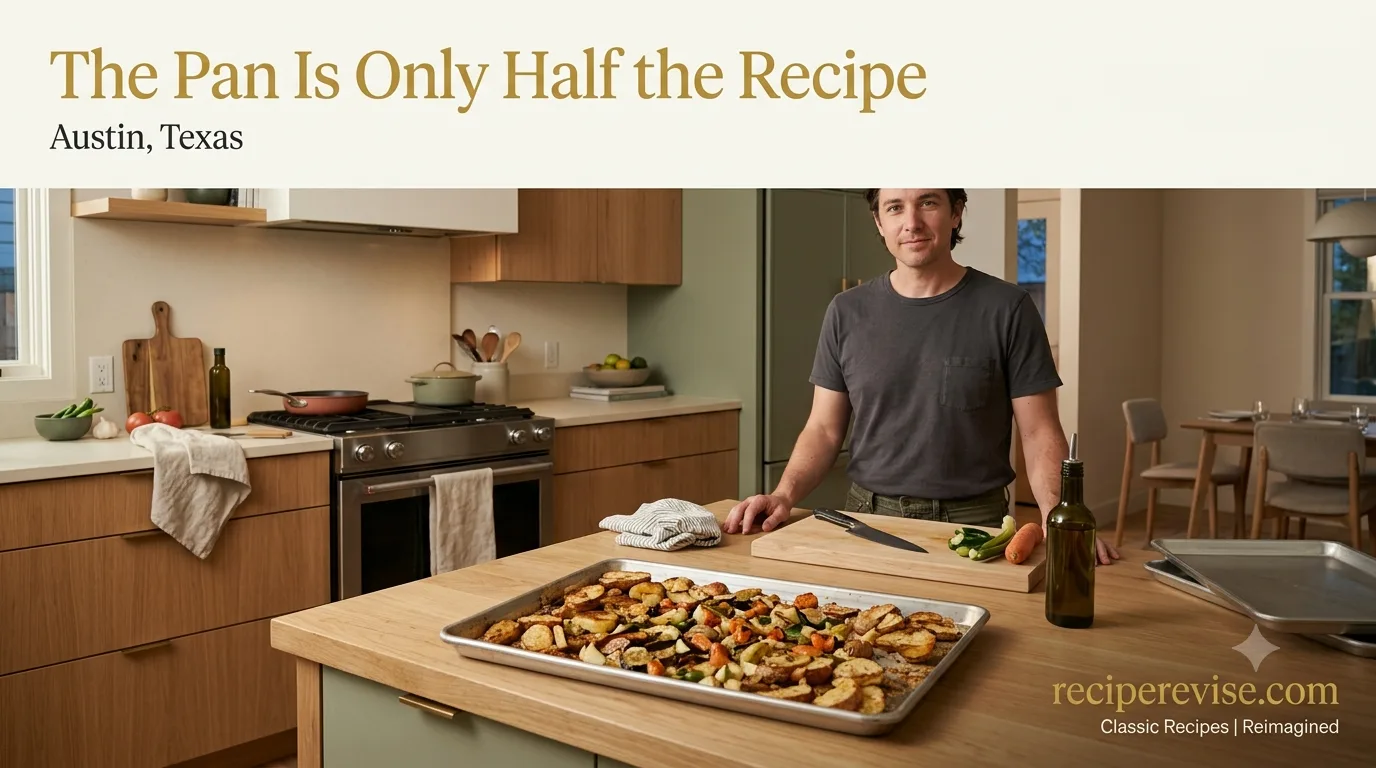
Sheet pan recipes made smarter: learn timing, spacing, and pan-size tricks for easy breakfasts, lunches, dinners, snacks, baking, and dessert. Save this guide.
Sheet-Pan Recipes for Every Meal
At 6:15 on a weeknight, the appeal of a sheet pan is obvious.
Dinner needs to happen. The refrigerator contains a few vegetables, perhaps some chicken or tofu, and nobody is volunteering to wash three skillets afterward.
So you reach for the largest rimmed pan you own.
That part is easy.
The harder part is knowing what belongs on the pan together, what should wait, how much space the food needs, and when a “one-pan meal” is actually better made on two pans.
That’s the difference between a sheet-pan dinner with browned vegetables, properly cooked protein and crisp edges—and a crowded pan of food that has steamed in its own moisture.
Sheet-pan cooking is much more than a collection of easy dinner recipes. The same basic piece of cookware can handle breakfast bakes, roasted lunches, weeknight dinners, appetizers, snacks, cookies, cakes and fruit desserts. Major recipe publishers continue to use the format across all of those categories; Food Network’s current sheet-pan collection, for example, includes breakfast, lunch-prep, dinner and dessert recipes. Food Network
The useful question, then, isn’t simply “What can I cook on a sheet pan?”
It’s:
How do I make different ingredients cook successfully on the same pan?
Once you understand that, sheet-pan recipes become less like fixed instructions and more like a cooking system.
Why Sheet-Pan Cooking Works
A sheet pan gives food something a deep casserole dish often doesn’t: surface area.
Food can spread into a relatively thin layer, allowing the hot oven to contact more of its exposed surface. That makes the pan useful for roasting vegetables, browning proteins and producing crisp edges. Food Network uses the same surface-area principle when adapting dishes such as macaroni and cheese and apple crumble to sheet pans. Food Network
It also explains why sheet-pan cooking is so versatile.
The pan can be:
- a roasting surface for vegetables and meat,
- a platform for fish or tofu,
- a breakfast griddle-by-proxy for eggs and hash,
- a baking surface for cookies and bars,
- a large-format dessert pan,
- or a way to cook enough food for leftovers.
But there is a catch.
A sheet pan doesn’t make ingredients cook at the same speed.
Potatoes and shrimp do not suddenly develop the same cooking time because they share an oven. Neither do chicken thighs and zucchini. A tray of vegetables can contain carrots that need substantially more time than thinly sliced peppers.
Successful sheet-pan cooking is therefore largely an exercise in managing time, space and moisture.
The Sheet-Pan Formula: Five Parts of a Good Meal
You don’t need a new recipe every time you want to cook from a sheet pan.
A useful starting framework is:
1. Choose an anchor.
Protein, tofu, beans, eggs or a substantial vegetable.
2. Add vegetables with compatible cooking times.
Cut dense vegetables smaller or give them a head start.
3. Add a starch when you want a more substantial meal.
Potatoes, sweet potatoes, gnocchi or another suitable starch can turn roasted ingredients into dinner.
4. Build a flavor base.
Think olive oil and garlic, chile and lime, soy and ginger, or lemon and herbs.
5. Finish with something fresh or contrasting.
A squeeze of lemon, fresh herbs, yogurt, a sharp dressing, cheese, pickled vegetables or toasted seeds can change the character of the finished dish.
The formula is deliberately flexible.
You could turn chicken, broccoli and potatoes into a lemon-herb dinner. Change the seasoning and finishing sauce, and the same basic structure can move toward a Mexican-inspired, Middle Eastern-inspired or Asian-inspired meal.
The important thing is not to force every ingredient into the oven at the same moment.
The Most Important Sheet-Pan Skill: Timing
If you learn only one technique from this guide, make it staggered cooking.
Instead of asking:
“Can these ingredients cook together?”
ask:
“Can these ingredients finish together?”
That’s a much better question.
Ingredients that usually need more time
Dense vegetables and larger pieces of food generally need more time than thin, delicate ingredients.
Examples include:
- potatoes
- sweet potatoes
- carrots
- winter squash
- large pieces of cauliflower
- thick cuts of meat
Ingredients that usually cook quickly
These may need to join the pan later:
- shrimp
- thin fish fillets
- asparagus
- zucchini
- thinly sliced peppers
- delicate greens
But don’t turn that list into a universal timetable. Thickness, starting temperature, oven temperature, pan material and recipe design all matter.
A Food Network breakfast bake provides a useful illustration: potatoes are partially cooked before roasting, while eggs are added near the end. Another current Food Network breakfast recipe cooks hash browns before adding the egg mixture. Food Network
That’s the principle in action:
The pan is shared. The clock isn’t.
Looking for another pantry-smart meal with serious depth? Recipe Revise’s mujadara turns lentils, rice, and deeply caramelized onions into a richly satisfying Middle Eastern classic.
A simple timing model
Think of the cooking process as a timeline rather than a single instruction.
Start:
Dense vegetables + ingredients needing the longest cooking time
↓
Middle:
Protein or medium-speed vegetables
↓
Later:
Quick vegetables or delicate foods
↓
Final minutes:
Cheese, glazes, delicate sauces or ingredients that should remain fresh
↓
After roasting:
Lemon juice, herbs, yogurt, fresh greens or other finishing ingredients
The exact timing belongs to the individual recipe. The framework is what transfers from one recipe to another.
The Pan Matters More Than Most Recipes Admit
A “sheet pan” isn’t one perfectly standardized object.
King Arthur Baking identifies the common half-sheet pan as approximately 13 × 18 inches, although actual interior dimensions can vary. It recommends choosing a pan that fits the oven while leaving room for heat circulation. King Arthur Baking
That matters because pan geometry changes the cooking environment.
Half-sheet vs. smaller pans
A half-sheet gives you more room to spread ingredients out.
That’s useful when roasting because overcrowding can work against the browning and crisping you’re trying to achieve.
A smaller pan can be perfectly appropriate for a smaller batch—but if you cram a recipe designed for a larger surface into it, the food may sit closer together and release moisture into the pan.
Sheet pan vs. cookie sheet
The terms are sometimes used interchangeably in everyday cooking, but they aren’t identical.
A traditional sheet pan has a rim around its edges. A cookie sheet may have one or more raised edges or a more open design intended to make cookies easier to slide off.
For roasting foods that release juices or fat, a rimmed pan is generally the safer practical choice because the edges help contain them.
Parchment isn’t mandatory
Parchment can make cleanup easier and can help with sticking.
But it isn’t a substitute for good pan spacing.
If the food is crowded, parchment won’t magically turn steaming into roasting.
And for some applications where you want direct contact between food and a hot metal surface, the pan itself is part of the browning equation.
When one pan should become two
This is one of the most useful rules in the entire article:
If the food has nowhere to spread, use another pan.
“One-pan” is a convenience, not a culinary law.
Two properly spaced pans can produce a better meal than one overloaded pan—and you may still be doing far less cleanup than if you cooked every component separately.
Sheet-Pan Breakfasts
The sheet pan has a particularly useful trick at breakfast: it can cook a batch of food at the same time.
That matters when you’re feeding several people.
Food Network’s current sheet-pan collection includes breakfast bakes, eggs, pancakes and breakfast sandwiches. Its breakfast bake, for example, combines potatoes, bacon, vegetables, toast and eggs, with the ingredients entering the pan at different stages. Food Network
That last detail is more important than the recipe itself.
A successful breakfast sheet pan might look like:
Potatoes → bacon/vegetables → toast → eggs
rather than putting everything into the oven simultaneously.
Good sheet-pan breakfast ideas
- crispy potato and egg hash
- bacon-and-egg breakfast squares
- sheet-pan pancakes
- roasted breakfast vegetables
- baked egg sandwiches
- breakfast potatoes with peppers and onions
- roasted fruit with an oat topping
For a crowd, the format can be especially useful because a large surface gives you a way to produce many portions without standing over a skillet.
Sheet-Pan Lunches and Meal Prep
Sheet-pan cooking doesn’t have to mean dinner.
A roasted protein and vegetables can become several different lunches if you change the finishing elements.
For example:
Roasted chicken + peppers + onions
can become:
- a grain bowl with a lemon dressing,
- a wrap with yogurt sauce,
- tacos with lime and salsa,
- a salad with beans,
- or a pita plate with hummus.
This is where sheet-pan cooking becomes particularly useful for meal prep: the base can stay relatively neutral while the finishing ingredients change.
The food-safety part matters
Cooked leftovers should be refrigerated promptly. USDA Food Safety and Inspection Service guidance says perishable food should not remain at room temperature for more than two hours, or one hour when the temperature is above 90°F. USDA also advises using most cooked leftovers within three to four days and reheating leftovers to 165°F as measured with a food thermometer. Food Safety and Inspection Service
For meal prep, shallow containers are useful for faster cooling.
The sheet pan gets the food cooked. It does not remove the need for safe storage.
Sheet-Pan Dinners: Build Around the Ingredient That Matters Most
Dinner is where the sheet pan has become most strongly associated with weeknight cooking.
Current recipe collections from Food Network and Epicurious continue to emphasize chicken, seafood, sausage, vegetables and globally influenced flavors. Food Network
Rather than treating every dinner as a separate recipe category, think about the anchor ingredient.
Chicken
Chicken thighs are particularly convenient for roasting because their shape and fat content can work well with vegetables and sauces.
Chicken breast can also work, but thickness matters. A thick breast and thinly sliced vegetables do not necessarily finish together.
For any poultry sheet-pan recipe, use a thermometer rather than appearance alone. USDA recommends a minimum internal temperature of 165°F for all poultry. Food Safety and Inspection Service
Fish and seafood
Fish generally needs less oven time than dense root vegetables.
That makes sequencing especially important.
You can roast potatoes first, then add salmon later. Shrimp may need less time still.
The goal is to finish everything at approximately the same time without drying the seafood while waiting for the vegetables.
USDA lists 145°F as the minimum internal temperature for fish and shellfish. Food Safety and Inspection Service
Beef and pork
The appropriate temperature depends on the cut and whether the meat is ground.
USDA recommends 145°F with at least a three-minute rest for beef, pork, lamb and veal steaks, chops and roasts, while ground meats should reach 160°F. Food Safety and Inspection Service
That distinction matters in a sheet-pan recipe because a thin ground-meat preparation behaves very differently from a thick roast.
Vegetarian sheet-pan dinners
A meatless sheet pan doesn’t need to feel like a side dish.
Use a combination of:
- chickpeas or another legume,
- potatoes or another substantial starch,
- cauliflower or another hearty vegetable,
- tofu,
- nuts or seeds,
- and a flavorful sauce.
The finishing element becomes particularly important here.
A spoonful of tahini sauce, a squeeze of lemon, a chile-lime dressing or a yogurt-based sauce can provide the contrast that turns roasted ingredients into a complete-feeling meal.
Sheet-Pan Appetizers and Snacks
The sheet pan is especially good at one thing that party food often needs:
surface area.
That’s useful for foods where crisp edges and browned toppings are desirable.
Consider:
- nachos
- roasted chickpeas
- seasoned nuts
- crispy potatoes
- baked quesadillas
- vegetable fritters
- roasted cauliflower bites
- party-style flatbreads
- baked wings
The trick is to avoid confusing “spread it over a large pan” with “put everything on the pan.”
Some foods need a barrier or separate preparation. Others release enough moisture to affect everything around them.
For snacks, the best sheet-pan recipes usually have a simple objective: maximize crispness, browning or batch size.
Sheet-Pan Baking and Desserts
This is where the sheet pan stops looking like dinner equipment and starts behaving like a baker’s workhorse.
King Arthur Baking notes that sheet pans can be used for cookies, cakes, roasted fruit and vegetables, among other applications. King Arthur Baking
And the large format has an obvious advantage:
more surface area means more edges.
That can be useful for people who prefer:
- crispy brownie edges,
- abundant crumble topping,
- thin cookie bars,
- slab pies,
- sheet cakes,
- roasted fruit,
- or large batches of baked goods.
Food Network similarly uses the pan to maximize browned and crunchy portions in dishes such as sheet-pan macaroni and cheese and apple crumble. Food Network
But baking has one important complication: pan dimensions change the depth of the batter.
You cannot automatically double a recipe simply because the area of a half-sheet appears to be roughly twice that of a smaller pan.
King Arthur Baking specifically warns that pan conversion involves more than multiplying the bottom area because the depth and side height also affect volume. King Arthur Baking
That is why a baking recipe written specifically for a half-sheet pan is preferable to improvising a conversion from a smaller cake pan.
Sheet-pan dessert ideas
- fruit crumble
- slab pie
- cookie bars
- brownies
- sheet cake
- roasted stone fruit
- baked apples
- large-format blondies
For baking, follow the recipe’s specified pan dimensions rather than assuming all sheet pans are interchangeable.
One Pan, Many Cuisines
A sheet pan is a technique, not a cuisine.
That distinction is useful because it lets you change the flavor architecture without rebuilding the cooking method.
| Flavor direction | Useful flavor building blocks | Good sheet-pan partners |
|---|---|---|
| Mediterranean-inspired | lemon, garlic, oregano, olive oil | chicken, potatoes, peppers |
| Mexican/Tex-Mex-inspired | chile, cumin, lime, beans | chicken, corn, peppers |
| Middle Eastern-inspired | cumin, coriander, tahini, herbs | chickpeas, cauliflower, chicken |
| South Asian-inspired | ginger, chile, spices, yogurt | cauliflower, chicken, potatoes |
| East Asian-inspired | soy, ginger, sesame | tofu, salmon, broccoli |
| Italian-American | tomato, garlic, basil, Parmesan | chicken, sausage, vegetables |
The wording matters.
A recipe influenced by the flavors of a particular cuisine isn’t automatically a traditional dish from that cuisine. “Inspired by” or a precise description is often more accurate than casually calling an adaptation “authentic.”
That lets the food be useful without flattening complex culinary traditions into a seasoning list.
If texture is what keeps cottage cheese off your breakfast table, Recipe Revise explains what blending actually changes—and why the technique works.
Why Sheet-Pan Recipes Fail
If your vegetables are pale and watery while the chicken is already finished, the recipe probably isn’t cursed.
The pan is telling you something.
1. The pan is overcrowded
This is the classic problem.
When too much food is packed together, there is less exposed surface for browning and more moisture being released into a confined space.
Fix: spread the food out, use a larger pan, or divide it between two pans.
2. Everything went in at once
Potatoes can need substantially longer than shrimp.
Fix: stagger the ingredients.
3. The pieces are different sizes
A carrot cut into a large chunk and a carrot cut into thin coins aren’t really the same ingredient from the oven’s perspective.
Food Network’s sheet-pan breakfast recipe specifically notes that cutting potatoes, peppers and onions to similar sizes helps promote even cooking. Food Network
Fix: aim for similar dimensions within each ingredient.
4. The sauce went on too early
Sugary glazes can darken before the underlying food is finished.
Wet sauces can also add moisture at exactly the wrong moment.
Fix: roast first, glaze later when the recipe calls for it.
5. You judged doneness by appearance
A browned exterior doesn’t tell you everything about what’s happening inside meat.
USDA notes that appearance and texture are not reliable indicators of whether meat has reached a safe temperature. A food thermometer is the reliable way to verify the recommended internal temperature. Ask USDA
Fix: use temperature for food safety and visual/texture cues for quality.
6. The oven or pan doesn’t match the recipe
A recipe written for a large, heavy half-sheet won’t necessarily behave identically on a small or thin pan.
And actual oven temperatures can vary.
Fix: pay attention to the recipe’s equipment, not just its ingredient list.
A Sheet-Pan Decision Tree for Busy Nights
When you don’t want to search for another recipe, start here.
You have chicken
Try:
Chicken + potatoes + broccoli + lemon-garlic seasoning
Start the potatoes first. Add the chicken according to its thickness and the recipe’s timing. Add broccoli later if it is cut into relatively small florets.
You have fish
Try:
Salmon + potatoes + asparagus + lemon
Roast the potatoes first. Add salmon and asparagus later.
You have tofu or chickpeas
Try:
Tofu or chickpeas + cauliflower + sweet potato + tahini-lemon sauce
Give the dense vegetables a head start. Crisp the tofu or chickpeas with enough space around them.
You have eggs
Try:
Potatoes + peppers + onions + eggs
Cook the vegetables first, then create spaces and add the eggs near the end.
You mostly have vegetables
Try:
Mixed roasted vegetables + a substantial finishing element
Add chickpeas, beans, cheese, nuts, seeds or a sauce to turn roasted vegetables into a meal rather than simply a tray of sides.
You need party food
Think:
surface area + crispness + easy portioning
Nachos, quesadillas, roasted snacks and baked flatbreads fit the format particularly well.
The Sheet-Pan Recipe Index
For a full site, this should become the article’s navigational hub rather than a wall of recipe names.
| If you want… | Build around… | Finish with… |
|---|---|---|
| Fast dinner | shrimp, thin fish or quick-cooking chicken | lemon, herbs, sauce |
| Family dinner | chicken thighs + potatoes | pan sauce or yogurt |
| Vegetarian dinner | chickpeas/tofu + vegetables + starch | tahini or herb sauce |
| Breakfast | eggs + potatoes + vegetables | cheese, herbs, hot sauce |
| Lunch prep | roasted protein + vegetables | dressing or grain |
| Appetizer | nachos, potatoes, flatbread | fresh toppings |
| Snack | chickpeas, nuts, vegetables | spice blend |
| Baking | cookies, bars, cake | icing, fruit or crumble |
| Dessert | fruit + crumb/batter | cream, yogurt or ice cream |
This is also where a publisher can link to individual recipes.
The guide should be the method hub; individual recipe pages should handle the complete recipe instructions.
Frequently Asked Questions
What can you cook on a sheet pan?
Almost any food suited to roasting or baking can potentially be adapted to a sheet pan, including vegetables, proteins, breakfast foods, snacks, cookies, cakes and desserts. The important limitation is that ingredients with substantially different cooking times may need to enter the oven at different points.
What is the easiest sheet-pan dinner?
A simple combination of a protein, a vegetable and a starch is a useful starting point. The easiest successful version is one in which the ingredients have compatible cooking times or can be staggered without complicated preparation.
How do you keep sheet-pan vegetables from getting soggy?
Give them space. Avoid overcrowding, use a suitable pan size, manage ingredients with high moisture, and don’t add wet sauces prematurely. If necessary, divide the food between two pans.
Should everything go on a sheet pan at the same time?
No. Staggering ingredients is often the key to getting everything finished together. Dense vegetables may need a head start while delicate foods join the pan later.
What size sheet pan is best?
A common half-sheet pan is approximately 13 × 18 inches, although actual dimensions vary. King Arthur Baking recommends choosing a pan that fits your oven with adequate clearance for heat circulation. King Arthur Baking
Do you need parchment paper for sheet-pan recipes?
No. Parchment can help with cleanup and sticking, but it doesn’t solve overcrowding or moisture problems. Whether to use it depends on the particular recipe and desired result.
Can you bake cookies on a sheet pan?
Yes. Sheet pans are commonly used for cookies and other baked goods. Pan material, dimensions and the depth of the batter can affect baking results, so follow the recipe’s specified pan where possible. King Arthur Baking
What temperature should chicken reach on a sheet pan?
USDA recommends cooking poultry to a minimum internal temperature of 165°F, measured with a food thermometer. Food Safety and Inspection Service
What temperature should fish reach?
USDA lists 145°F as the minimum internal temperature for fish and shellfish. Food Safety and Inspection Service
How long are sheet-pan leftovers safe in the refrigerator?
USDA advises using most cooked leftovers within three to four days and refrigerating perishable food promptly. Leftovers should be reheated to 165°F. Food Safety and Inspection Service
The Real Secret to Better Sheet-Pan Cooking
The sheet pan isn’t a magic shortcut.
It’s a piece of geometry.
You have a limited surface, a certain amount of food, different cooking speeds and a finite amount of oven heat. Once you understand those variables, the recipes become much easier to improvise.
If the food needs to brown, give it space.
If an ingredient needs longer, give it a head start.
If something cooks quickly, let it arrive later.
If a sauce burns easily, don’t expose it to unnecessary oven time.
If the pan is too crowded, use another one.
And if you’re cooking meat, don’t let a browned exterior substitute for a thermometer.
That’s the shift that makes sheet-pan cooking genuinely useful. You stop asking whether a recipe exists for the ingredients in your refrigerator and start asking how those ingredients can finish well together.
Dinner becomes one possible use of the pan rather than its entire purpose.
Tomorrow morning, the same piece of cookware might hold eggs and potatoes. At lunch, roasted vegetables become filling for a wrap. In the evening, salmon and asparagus take the place of chicken. On the weekend, the pan becomes a vehicle for cookies, a slab pie or a fruit crumble.
The sheet pan isn’t the recipe.
It’s the surface on which the recipe becomes possible.
SOURCES / REFERENCES
- U.S. Department of Agriculture, Food Safety and Inspection Service — Safe Minimum Internal Temperature Chart
USDA FSIS Safe Minimum Internal Temperature Chart
Supports: Minimum internal temperatures for poultry, ground meat, fish, eggs, steaks/chops/roasts and leftovers.
Current page: accessed during final verification; page published/updated in recent years. Food Safety and Inspection Service - USDA FSIS — Keep Food Safe! Food Safety Basics
USDA FSIS Food Safety Basics
Supports: Two-hour rule, shallow containers, three-to-four-day leftover guidance and reheating temperature. Food Safety and Inspection Service - USDA FSIS — Leftovers and Food Safety
USDA FSIS Leftovers and Food Safety
Supports: Reheating leftovers to 165°F and storage guidance. Food Safety and Inspection Service - Food Network Kitchen — 65 Sheet Pan Recipes
Food Network — Sheet Pan Recipes
Supports: Current breadth of sheet-pan applications, including breakfast, lunch preparation, dinner and dessert; examples of staggered cooking and contemporary recipes.
Updated: April 13, 2026. Food Network - Food Network Kitchen — Sheet Pan Breakfast Bake
Food Network — Sheet Pan Breakfast Bake
Supports: Practical example of sequencing potatoes, bacon, vegetables, toast and eggs; same-size cutting guidance. Food Network - Food Network — Better on a Sheet Pan
Food Network — Better on a Sheet Pan
Supports: Surface-area explanation and sheet-pan adaptations of comfort foods and desserts. Food Network - Epicurious — Sheet-Pan Dinners
Epicurious — Sheet-Pan Dinners
Supports: Current breadth of sheet-pan dinner recipes and flavor directions. Epicurious - King Arthur Baking — Your Complete Guide to Baking Pans
King Arthur Baking — Complete Guide to Baking Pans
Supports: Common half-sheet dimensions, oven clearance, pan construction and sheet-pan baking uses. King Arthur Baking - King Arthur Baking — Big Batch Brownies and Bars
King Arthur Baking — Big Batch Brownies and Bars
Supports: Why pan conversion depends on more than simply doubling surface area. King Arthur Baking - Google Search Central — AI Features and Your Website
Google Search Central — AI Features and Your Website
Supports: Google’s current guidance that foundational SEO and helpful, reliable, people-first content remain the basis for visibility in AI Overviews and AI Mode; no special AI markup is required. Google Developers - Google Search Central — Guide to Generative AI Features
Google Search Central — Generative AI Features Guide
Supports: Emphasis on unique, useful, non-commodity, people-first content rather than content created primarily for search manipulation.