
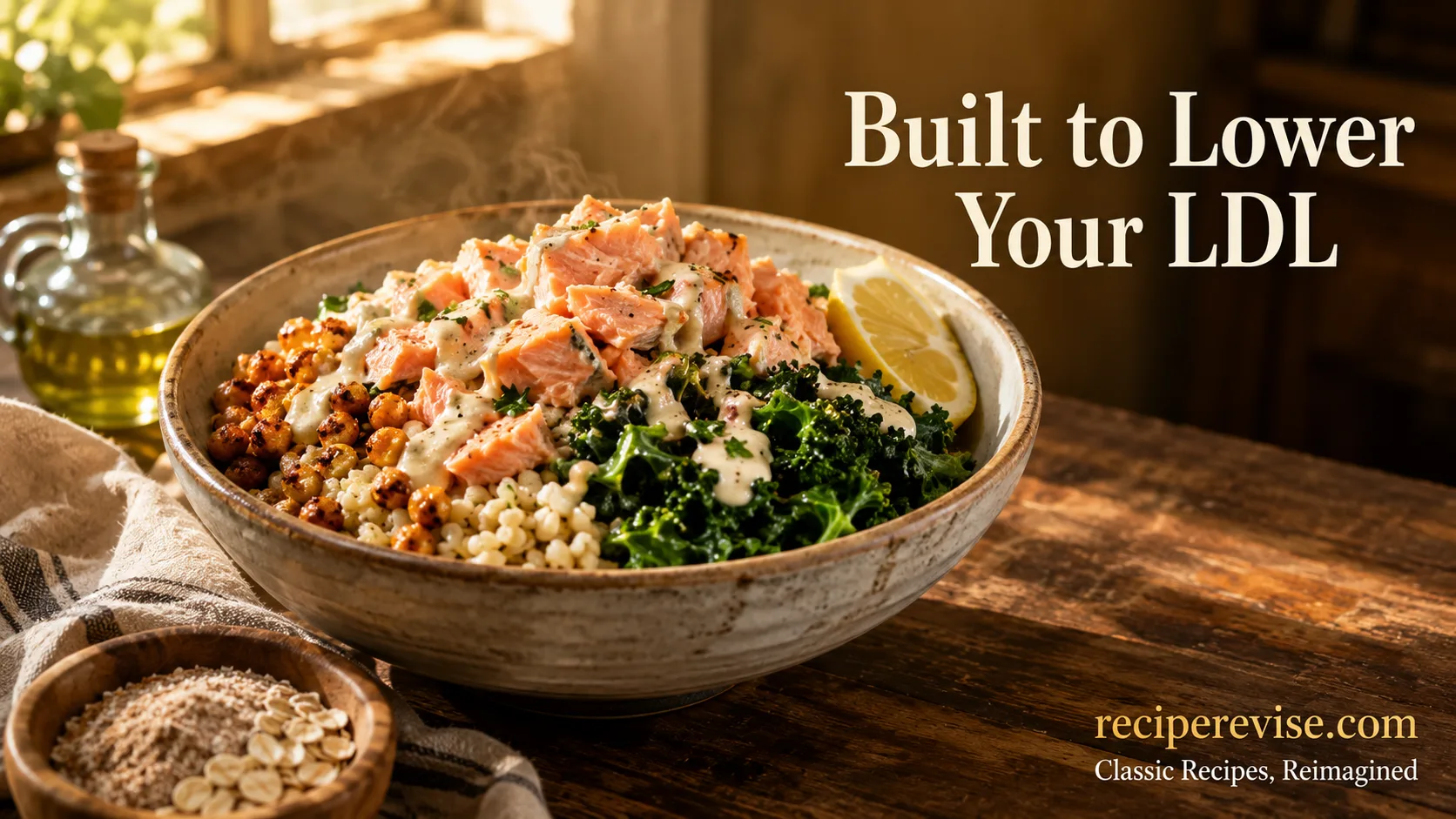
A research-backed 7-day meal plan using soluble fiber, plant sterols, and a real fat swap to help lower LDL cholesterol. Printable grocery list included.
Direct answer:
Lowering LDL cholesterol through food comes down to three levers pulled together: enough soluble fiber to hit a real clinical dose (not a token bowl of oatmeal), a daily 2 grams of plant sterols, and a genuine swap of saturated fat for unsaturated fat rather than just cutting back. This plan builds all three into one shoppable week.
I’ve watched a lot of people do the “heart-healthy” thing halfway. They swap butter for olive oil at dinner, then eat a bagel with two fried eggs and bacon for breakfast because nobody told them fiber has a dose-response curve, and mornings are where most of us lose the day’s whole fiber budget before 9 a.m.
Why Most Cholesterol Advice Stops at “Eat More Oatmeal”
Here’s the part almost nobody says out loud: a half-cup of dry oats a few mornings a week won’t move your LDL in any way a lab test would notice. The research behind fiber and cholesterol is dose-dependent, and most people never get near the dose.
A large dose-response meta-analysis covering 181 randomized trials and over 14,000 participants found that every additional 5 grams per day of soluble fiber produced roughly a 5.5 mg/dL drop in LDL cholesterol, layered on top of a similar drop in total cholesterol. That’s not nothing, but it’s also not a rounding error you get from one granola bar. It’s a target you build a whole day around — breakfast, lunch, and a snack, not just breakfast (Nourished by Science).
That’s the actual argument of this article: less “eat clean,” more “hit the number.” Every day in this plan is built backward from three measurable targets — soluble fiber, plant sterols, and the saturated-fat-to-unsaturated-fat ratio on your plate — instead of vague virtue.
How Much Soluble Fiber Actually Moves Your LDL Number?
Direct answer: Aim for 10–15 grams of soluble fiber daily, spread across meals. Research shows LDL drops roughly 5–6 mg/dL for every 5-gram increase, with viscous fibers like oat beta-glucan, psyllium, and legumes working best. A single high-fiber breakfast isn’t enough — the effect depends on steady daily intake, not one big dose.
Oat beta-glucan is the fiber with the clearest regulatory backing. Six grams a day, taken for six weeks, produced a measurable drop in both total and LDL cholesterol in a randomized trial of adults who started with elevated levels — and it’s fermentable in the gut, which is part of why it also boosted short-chain fatty acid and butyrate production comparable to inulin and guar gum. Butyrate matters for colon health, which is a nice side effect nobody’s marketing on the cereal box (PubMed).
Psyllium works a little differently and slightly less dramatically gram-for-gram than oat bran, but it’s more concentrated — a tablespoon of husk gets you 3-4 grams of soluble fiber in one spoonful, which is why it shows up more than once in this week’s plan, stirred into overnight oats or a smoothie rather than taken as a chalky supplement shot.
The Four Fibers Worth Building a Grocery List Around
| Fiber source | Soluble fiber per serving | Best use in this plan |
|---|---|---|
| Oat bran / rolled oats | ~2g soluble fiber per ½ cup dry | Overnight oats, savory oat bowls |
| Psyllium husk | ~3-4g per tablespoon | Stirred into oats, smoothies, or baked into muffins |
| Cooked black or kidney beans | ~2-3g per cup | Grain bowls, soups, taco filling |
| Barley or chickpeas | ~2g per cup cooked | Salads, side grains |
A cup of cooked beans plus a bowl of oats already gets a reader most of the way to the 10-gram mark before lunch — no supplement pill required, though psyllium husk stirred into a morning bowl is the fastest way to close the gap on a rushed day.
Do Plant Sterols Work, and Do You Actually Need a Fortified Spread?
Direct answer: Yes — 2 grams of plant sterols or stanols daily lowers LDL by roughly 8-10%, and yes, you likely need fortified foods to hit that number. A typical Western diet only supplies 200-400 mg of sterols naturally, nowhere near the effective dose, which is why sterol-enriched spreads or supplements are the practical route.
This is the one place where “eat more vegetables” genuinely won’t get you there. Studies have shown that a daily diet containing 2 grams of phytosterols correlates with an 8% to 10% lower LDL cholesterol level, and it’s the basis of an FDA-authorized heart-health claim on sterol-fortified spreads and yogurt drinks. The catch: whole foods like almonds, avocado, and wheat germ contain sterols, but only in small amounts — a handful of almonds gets you maybe 40 mg, a rounding error against a 2,000 mg target (Benecol).
Practically, that means this week leans on a sterol-fortified spread on toast and in savory oat bowls, plus naturally sterol-rich foods (wheat germ sprinkled on yogurt, sesame seeds in stir-fries) filling in the rest. It’s the one ingredient on the grocery list worth reading labels for — look for “plant sterols” or “stanol esters” specifically, not just “cholesterol-free,” which means nothing here.
The Saturated Fat Swap That Beats Simply Cutting Back
Cutting saturated fat and not replacing it with anything specific barely moves the needle — plenty of low-fat diets from the 1990s proved that the hard way, when people just added refined carbs instead. The swap has to go somewhere.
“Replacing saturated fat with polyunsaturated vegetable oil in randomized trials cut cardiovascular disease risk by roughly 30 percent — about what a statin does.” — synthesis of AHA advisory findings
That’s a striking number to sit with. A Presidential Advisory from the American Heart Association concluded that trials replacing saturated fat with polyunsaturated oils reduced cardiovascular events by close to a third, while swapping saturated fat for refined carbohydrates and sugar showed no such benefit. The AHA’s current target is under 6% of daily calories from saturated fat — tighter than the older “less than 10%” guidance most of us grew up hearing (AHA Journals).
What Goes Out, What Comes In, Plate by Plate
- Butter on toast → sterol-fortified spread or avocado mash
- Ground beef in taco filling → lentils or a beef-lentil half-and-half blend
- Coconut oil for sautéing → extra-virgin olive oil or avocado oil
- Full-fat cheese as the main protein → a smaller amount of sharp cheese plus beans for bulk
- Cream-based soup base → pureed white bean or cauliflower base
Small print, big effect: this only works if the swap actually lands on your plate that day. Buying olive oil and leaving the butter in the fridge “for special occasions” doesn’t count.
Where Do Omega-3s Actually Fit In a Cholesterol Plan?
Direct answer: Omega-3s aren’t primarily an LDL tool — they’re a triglyceride and inflammation tool. Two servings of fatty fish weekly (about 6-8 oz total) is the general target; at prescription-level doses of 4 grams daily, omega-3s can lower triglycerides significantly, but they don’t reliably lower LDL and can nudge it slightly upward in some people.
This is the mix-up I see constantly, on this site’s comment section and off it: people load up on fish oil expecting an LDL win. That’s not really the job omega-3s do. The American Heart Association recommends two servings of fatty fish per week — salmon, sardines, mackerel — mainly for triglyceride and inflammatory benefits, not cholesterol-panel bragging rights.
If fish isn’t a regular thing for you, walnuts and ground flaxseed supply ALA, the plant-based omega-3, though your body converts it to the more active forms inefficiently. Either way, treat omega-3s as the fourth pillar that supports heart health broadly — not the lever that does the LDL work. That job belongs to fiber, sterols, and the fat swap above.
Your 7-Day Cholesterol-Lowering Meal Plan
Each day targets roughly 10-15g soluble fiber, includes a sterol-fortified food, and keeps saturated fat to a genuine minimum — not a “mostly” minimum.
| Day | Breakfast | Lunch | Dinner |
|---|---|---|---|
| Mon | Psyllium overnight oats + walnuts | Black bean & barley bowl | Salmon, olive oil, lentil-cauliflower mash |
| Tue | Sterol-spread toast + avocado | Chickpea salad, tahini dressing | Turkey-lentil chili |
| Wed | Oat bran porridge + flaxseed | Leftover chili, whole grain roll | White bean, kale, olive oil soup |
| Thu | Greek yogurt, wheat germ, berries | Barley & roasted veg bowl | Mackerel with white beans |
| Fri | Psyllium smoothie (banana, oat milk) | Bean & barley salad, cold | Bean-lentil taco filling, corn tortillas |
| Sat | Savory oat bowl, egg, avocado | Leftover tacos | Baked cod, chickpea sauté |
| Sun | Sterol-spread toast, sliced almonds | Big-batch bean chili (freeze extra) | Grain bowl with roasted chickpeas |
If your household already runs on a higher-protein, lower-sodium rhythm — say, for blood pressure alongside cholesterol — this plan layers cleanly onto our 7-day high-protein, low-sodium meal plan, since the bean-and-fish backbone overlaps almost entirely.
The Grocery List, Ready to Print
Check off what’s already in your pantry before you shop — most weeks, it’s shorter than it looks.
- Rolled oats / oat bran
- Psyllium husk
- Dried or canned black beans, kidney beans, chickpeas, lentils
- Pearl or hulled barley
- Plant sterol-fortified spread (check label for “plant sterols” or “stanol esters”)
- Extra-virgin olive oil, avocado oil
- Salmon, mackerel, sardines, cod (fresh or canned)
- Walnuts, ground flaxseed, sesame seeds, wheat germ
- Greek yogurt (plain)
- Avocados
- Kale, cauliflower, mixed roasting vegetables
- Whole grain tortillas or rolls
One Recipe to Anchor the Week: Pepper’s Psyllium Chickpea and Salmon Bowl
This is the dish I default to twice a week — it hits soluble fiber, sterols (via the olive oil and a spoonful of tahini), and omega-3s in one bowl, no separate side dishes required.
Yield: 2 servings Prep time: 10 minutes Cook time: 15 minutes
Ingredients:
- 1 can chickpeas, drained and rinsed
- 1 tablespoon psyllium husk
- 5 oz salmon fillet
- 2 tablespoons extra-virgin olive oil
- 1 tablespoon tahini
- 1 cup cooked barley
- 2 cups baby kale
- Juice of half a lemon
- Salt, black pepper, cumin to taste
Instructions:
- Pat the salmon dry, season with salt, pepper, and cumin. Pan-sear in 1 tablespoon olive oil over medium-high heat, about 4 minutes per side, until it flakes easily.
- While the salmon cooks, toss chickpeas with the remaining olive oil, a pinch of cumin, and a light sear in the same pan for 3-4 minutes, until lightly golden.
- Whisk tahini, lemon juice, and 2 tablespoons water into a loose dressing. Stir the psyllium husk into the dressing and let it thicken for 2 minutes.
- Build the bowl: barley on the bottom, kale massaged with a squeeze of lemon, chickpeas, flaked salmon, dressing on top.
Nutrition note: roughly 9g fiber per bowl before the barley’s contribution — pair it with an oat-based breakfast the same day and you’ll clear 15g soluble fiber before dinner’s even done.
Frequently Asked Questions
Can diet alone lower cholesterol as much as medication?
For most people with mild to moderately elevated cholesterol, diet changes can produce meaningful drops — sometimes double digits in percentage terms — but statins typically produce larger, more predictable reductions. Diet and medication aren’t competing strategies; many people need both, and food changes often let a lower medication dose work just as well.
How long does it take for high-fiber eating to lower cholesterol?
Most trials showing measurable LDL reductions ran 4 to 12 weeks of consistent daily intake. You’re unlikely to see a change on a lab test after a single “healthy week” — think in terms of a full quarter of steady habits before your next cholesterol panel.
Is oatmeal alone enough to lower cholesterol?
Not usually, at typical serving sizes. A half-cup of dry oats supplies roughly 2 grams of soluble fiber — useful, but well under the 5-10 gram range where studies show a clear LDL effect. Oatmeal works best as one part of a fiber-dense day, not the whole strategy.
Do I need a sterol-fortified spread, or will food sources work?
Practically, yes, for most people — natural sterol content in whole foods rarely exceeds a few hundred milligrams daily, far short of the 2-gram target linked to LDL reduction. Fortified spreads, yogurt drinks, or supplements are the realistic way to close that gap.
Are eggs off-limits on a cholesterol-lowering meal plan?
No — current guidance has moved away from treating dietary cholesterol in eggs as the main dietary villain; saturated fat has a bigger measurable effect on blood LDL for most people. Moderate egg intake fits fine here, especially paired with fiber-heavy sides rather than bacon and butter.
If some nights just call for something more forgiving than a fiber bowl, our GLP-1-friendly comfort food collection covers that territory without abandoning the plate-composition logic you’re building this week.
That psyllium habit feels strange for about four days and then just becomes what a smoothie is — which, honestly, is the whole trick to any of this sticking.
— Pepper Sage