
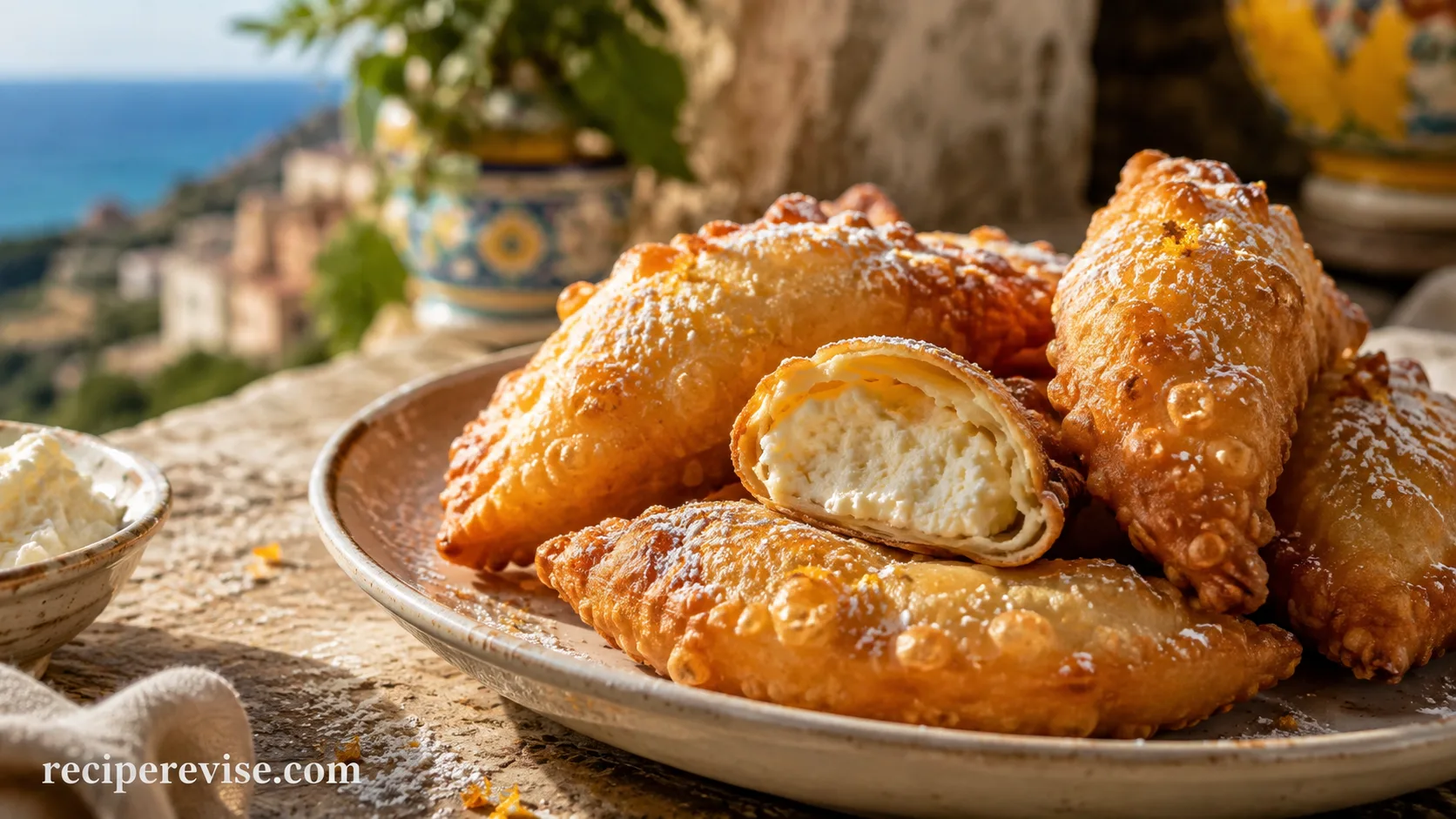
Alright, real talk. You know cannoli. You know cassata. You probably even know arancini — or arancine, depending who you ask (we’ll get into that turf war later). But have you ever heard of Iris? Not the flower. Not the app permission your phone keeps nagging you about. I’m talking about a golden, breadcrumb-crusted, deep-fried ball of brioche dough stuffed with a ricotta filling so silky it should come with a warning label.
If that’s a blank stare, don’t sweat it — most Italians outside Sicily are in the same boat. This thing is a straight-up local legend that never got its main-character moment beyond the island. Let’s fix that.
Okay, But What Even IS an Iris?
Picture a jelly donut. Now give it a glow-up: swap the glaze for a crackly breadcrumb shell, trade the jelly for a cloud of sweetened ricotta (sometimes loaded with chocolate chips), and fry the whole situation until it’s the color of a Sicilian sunset. That’s an Iris. Soft and custardy inside, shatteringly crisp outside — it’s what Palermo eats for breakfast when granita and a brioche just aren’t gonna cut it.
Technically it’s a “brioscia” — a soft, faintly sweet brioche bun — that gets stuffed, breaded, and fried. Some bakeries bake theirs instead, for a lighter version. Which, sure, you can do. But that’s like ordering the salad at a steakhouse. Why would you?
Wait, It’s Named After an Opera?
Yeah, and the story’s wild. Back in 1901, a Palermo pastry chef named Antonio Lo Verso was running his café and wanted something special to mark the local staging of “Iris,” a tragic opera by composer Pietro Mascagni. So he grabbed a bread roll, hollowed it out, stuffed it with sweetened ricotta, breaded it, and fried it. Named it after the opera.
The thing blew up so hard that Lo Verso eventually renamed his entire café “Pasticceria Iris.” For decades it was THE spot in Palermo — the kind of place where people closed business deals over espresso and fried ricotta buns. Sadly, after nearly a century in business, Pasticceria Iris shut its doors for good. But the pastry it left behind? Still going strong, well over 120 years later.
Here’s the part nobody mentions, though: the opera itself is dark. We’re talking about a sheltered young woman kidnapped by a con man, tricked into a brothel, publicly humiliated, and — depending on the staging — she ends things by throwing herself down a sewer shaft rather than live with the shame. One critic flat-out called it opera’s “shabby little shocker.” And somehow, that’s the namesake of a cheerful little breakfast pastry your nonna hands you with a smile and a napkin. Peak Sicilian irony.
The Original Iris Was Basically Recycled Bread (And That’s Genius)
Here’s a tidbit that never makes it into the pretty food-blog photos: the very first Iris wasn’t made with fancy brioche dough at all. Lo Verso’s original version used a plain, slightly stale bread roll — he’d slice it open, hollow out the crumb, moisten the shell with a splash of milk, stuff it with the ricotta filling, then bread and fry it.
That’s peak Sicilian cucina povera logic: take something humble — day-old bread — and turn it into something people line up to pay for. Same “waste nothing” thinking that gave us arancine (leftover risotto, breaded and fried) and pani ca meusa (the cuts of beef nobody else wanted, turned into a beloved sandwich). Sicily was doing “trash to treasure” cooking long before it was a hashtag.
Palermo vs. Catania: A Friendly Food Fight
Ask someone from Palermo what goes inside an Iris and they’ll look at you funny for even asking: ricotta. That’s it. Clean, classic, done.
Cross over to Catania, though, and things get extra. Chocolate chips, pastry cream, pistachio — Catanese bakers treat plain ricotta as a jumping-off point, not the finish line. Same energy as the arancina/arancino fight (round versus cone-shaped, and do NOT get a Sicilian started on which city’s got it right) — total regional pride, and you get to eat the results either way.
It’s Not Just Breakfast, Either
Genuinely under-the-radar fact: Iris isn’t a strictly sweet thing. Walk into a Sicilian rosticceria — the savory cousin of the pasticceria, where arancine and panelle live — and you might spot a savory Iris sitting right there on the counter. Same breaded, fried shell, but instead of ricotta, it’s packed with meat ragù, or even a full “alla Norma” situation (eggplant, tomato, salty ricotta). Turns out the Iris format is basically a Sicilian Swiss Army knife: sweet for breakfast, savory for lunch, fried both times.
Sicily’s Best-Kept Secret
Cannoli and cassata get all the tourist glory — every gift shop from Palermo to Taormina is stocked with cannoli kits and cassata magnets. Iris? You mostly find that one in the wild, at an actual bakery counter, eaten standing up, still too hot to hold still. It never got “discovered” the way its cousins did, which honestly just makes it taste better. You feel like you’re in on something.
Let’s Make Some
Enough history class. Time to fry some dough.
What You’ll Need
For the dough:
- 4 cups (500g) all-purpose flour, plus extra for dusting
- ⅓ cup (65g) granulated sugar
- 2¼ tsp instant yeast (one packet)
- ¾ tsp fine salt
- Zest of 1 lemon
- ¾ cup (180ml) whole milk, warmed to about 100°F
- 2 large eggs, room temperature
- 6 tbsp (85g) unsalted butter, softened and cut into small pieces
For the filling:
- 2 cups (450g) whole-milk ricotta (sheep’s milk if you can track it down — worth the hunt), drained overnight
- ¾ cup (85g) powdered sugar, sifted
- 1 tsp vanilla extract
- ½ cup (85g) mini chocolate chips, frozen for 30 minutes (optional, but strongly encouraged)
- Pinch of cinnamon
For breading and frying:
- 2 large eggs, beaten with 2 tbsp milk and a pinch of salt
- 2 cups (200g) plain dry breadcrumbs
- Neutral oil (peanut or sunflower), enough for 3 inches in a heavy pot
- Powdered sugar and cinnamon, for dusting
How to Do It
- Wake up the dough. In a stand mixer bowl fitted with the dough hook, combine flour, sugar, yeast, salt, and lemon zest. Add the warm milk and eggs. Mix on low until a shaggy dough forms, about 3 minutes.
- Butter it up. With the mixer running, add the softened butter a couple pieces at a time, letting each addition absorb before adding more. Keep kneading until the dough is smooth, elastic, and pulling cleanly away from the bowl — 8 to 10 minutes.
- Let it rise. Shape into a ball, place in a lightly oiled bowl, cover, and let rise somewhere warm for about 2 hours, or until doubled.
- Handle the ricotta. While the dough rises, make sure your ricotta’s been draining in a cheesecloth-lined strainer in the fridge overnight (don’t skip this — see the hacks below for why). Once drained, whisk with powdered sugar and vanilla until smooth. For extra-silky filling, push it through a fine mesh sieve. Fold in the frozen chocolate chips and cinnamon if using. Chill until ready.
- Divide and rest. Punch down the risen dough and divide into 10 pieces (about 80g each). Roll each into a smooth ball, cover with a towel, and rest for 15 to 20 minutes.
- Fill ’em up. Flatten each ball into a disc about 4 inches wide. Spoon 1½ to 2 tablespoons of filling into the center. Gather the edges up and around the filling, pinching tightly to seal completely — no leaks allowed in the fryer. Roll gently between your palms to smooth into a ball, seam-side down.
- Second rise. Place filled balls seam-side down on a parchment-lined tray, spaced apart. Cover loosely and let rise 45 minutes to an hour, until puffy.
- Bread ’em. Set up a breading station: egg wash in one bowl, breadcrumbs in another. Dip each ball in egg wash, then roll in breadcrumbs until fully coated. For that extra-crunchy rosticceria-style shell, repeat the egg-and-crumb process a second time.
- Fry. Heat oil to 350°F (175°C) in a heavy pot. Fry 2 to 3 at a time — don’t crowd the pot — turning occasionally, about 4 to 5 minutes total, until deeply golden brown all over.
- Drain, dust, devour. Transfer to a wire rack or paper towels to drain. While still warm, dust generously with powdered sugar and a little cinnamon. Eat immediately — Iris waits for no one.
Makes about 10 pastries.
Nonna-Approved Hacks Nobody Tells You
- The overnight ricotta drain is not optional. Skip it and you get a weepy, watery filling that blows the shell out mid-fry. Nobody wants ricotta soup in their frying oil.
- Freeze your chocolate chips first. Room-temp chips melt into the warm ricotta and turn your clean white filling into a muddy mess. A quick freeze keeps them intact until they hit the hot oil.
- Double-dredge for extra crunch. One pass through egg and breadcrumbs is fine. Two passes is how the pros at Palermo rosticcerie get that thick, shatter-crisp shell.
- These freeze beautifully — uncooked. Assemble and bread your Iris, then freeze on a tray before bagging up. Fry straight from frozen whenever the craving hits; just add an extra minute or two of fry time. Future-you says thanks.
- Don’t overstuff. Tempting to go heavy on the ricotta, but an overfilled Iris is a ticking time bomb in hot oil. Stick to the measurements.
- No fryer? No problem (sort of). Bake at 375°F (190°C) for about 20 minutes for a lighter version. Just know Sicilian purists will consider this a personal betrayal.
Serve warm, ideally with strong coffee, maybe alongside a granita if you’re going full Sicilian-breakfast mode. Just don’t tell Palermo you found out about their best-kept secret from a food blog.